Dr. Gymbro
←

#ketone monoester

1 article
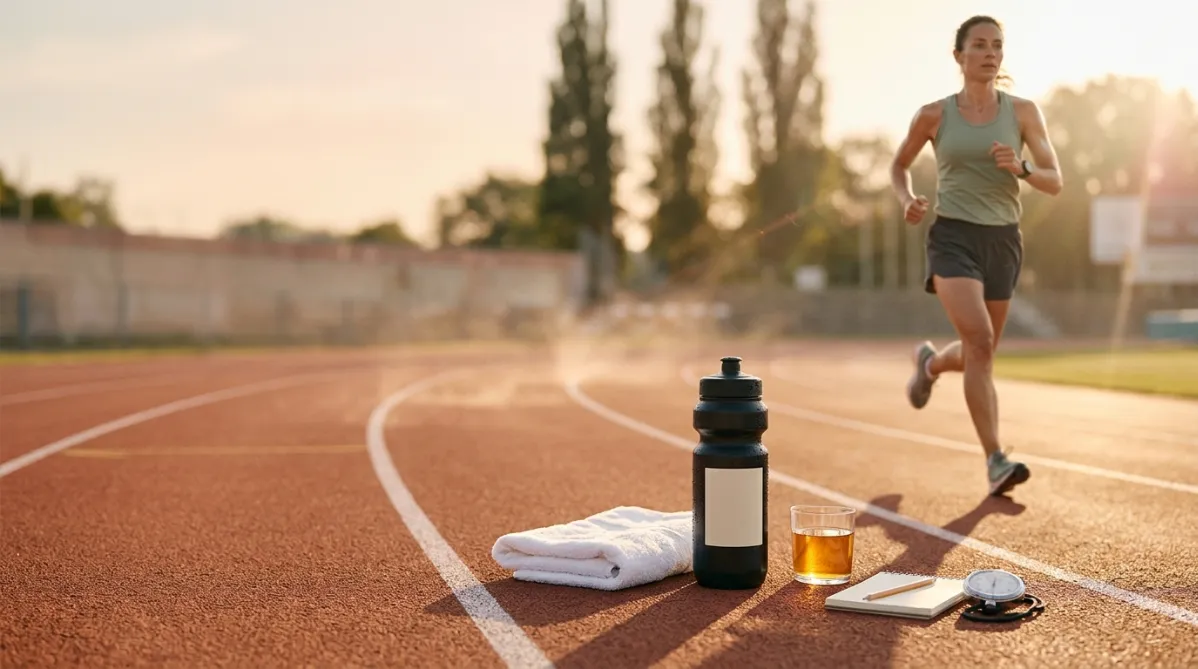
A sunlit outdoor running track in late afternoon, shot from a low angle with shallow depth of field. In the foreground, a matte black bottle with a minimal off-white label sits on the edge of a warm terracotta-colored track lane, beside a folded white towel and a small glass of amber liquid catching golden light. Condensation beads on the bottle. A faint heat shimmer rises from the track surface and softens the background.

In the midground, slightly out of focus, a lean athlete in a sage-green tank top and charcoal shorts runs on a treadmill-like stretch of track, a thin sheen of sweat on their shoulders, their expression focused and calm. Their motion is gently blurred, suggesting endurance and rhythm. Long soft shadows stretch across the lane lines.

The background fades into hazy peach, apricot, and pale yellow tones, with the suggestion of tall trees and a distant stadium wall. Warm sun flare enters from the upper right, creating a subtle glow and a few soft light streaks across the frame.

Subtle editorial touches: a small notebook with a pencil and a stopwatch rest beside the bottle, hinting at data and timing without any text legible. The color palette is warm and muted, with terracotta, cream, sage, and charcoal accents, and a fine film-like grain. The composition leaves open negative space on the left third for a headline overlay. The overall mood is clean, modern, and health-journal inspired, natural and aspirational, with a calm scientific curiosity rather than hype.
nutrition

Bebidas de cetona en el calor: ¿Más resistencia y mejor memoria?

BY DR. GYMBRO ·

Se dice que las bebidas de cetona son para los biohackers que buscan quemar grasa, pero un nuevo ensayo bajo estrés térmico sugiere que también pueden ayudar a terminar más fuerte. En 17 hombres entrenados, el monoéster de cetona más cafeína extendió el tiempo hasta el agotamiento a 8,9 minutos frente a 7,0 con carbohidratos más cafeína, después de 90 minutos de ejercicio en cinta a 34 °C. La precisión de la memoria de trabajo en la tarea de 1‑back también mejoró, mientras que la frecuencia cardíaca y la temperatura central no mostraron diferencias relevantes. Sin embargo, en la tarea de 2‑back, el tiempo de reacción y la prueba de golpear‑evitar no hubo beneficio, y el estudio es pequeño, solo con hombres y de una sola sesión.

This page is available in